
Learning experience
The educational role of the Historical Archive
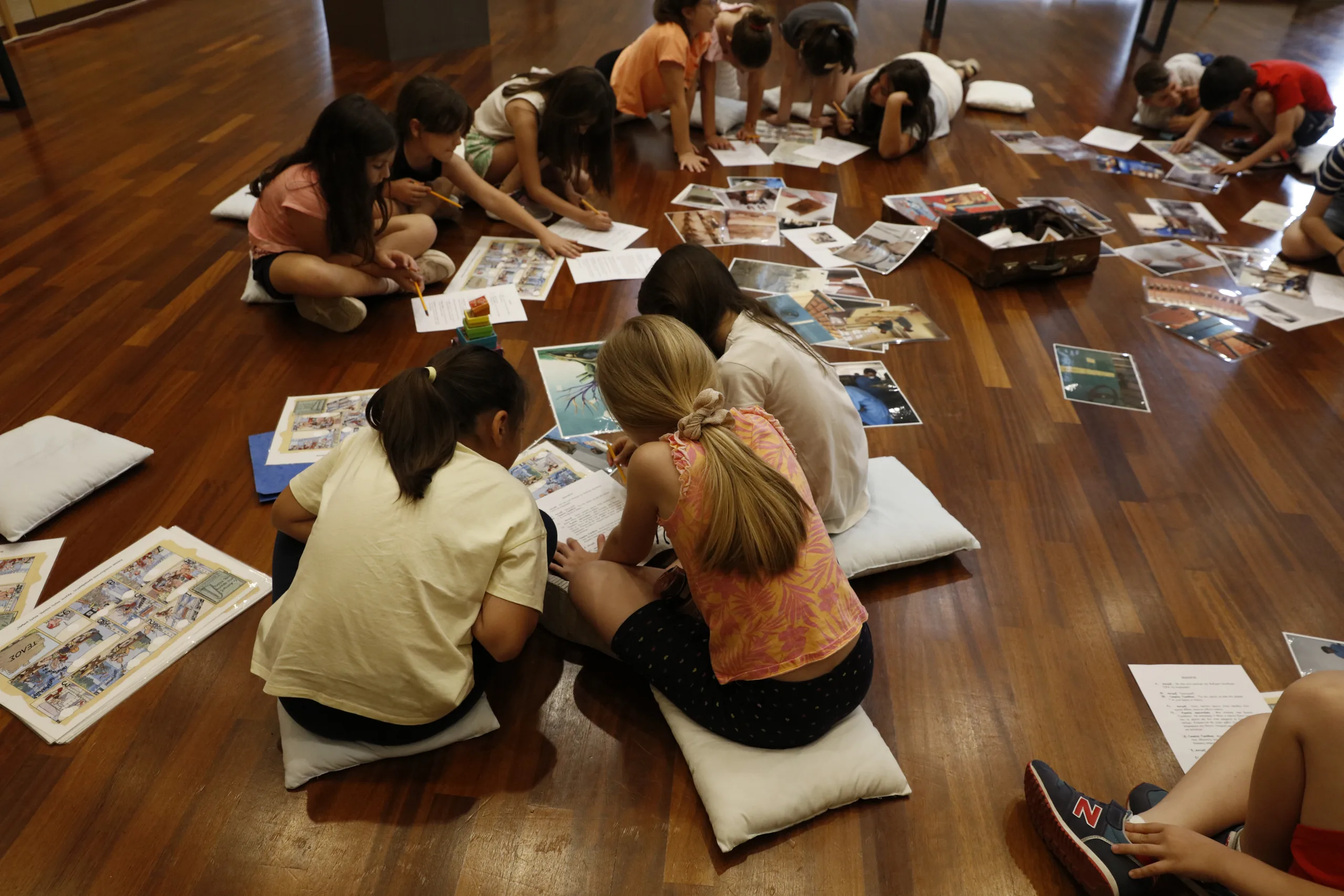
The Historical Archive of National Bank of Greece (HA/NBG) began to offer educational programs in the 2005–2006 academic year. Since then, both the number of available programs and the number of participating students have significantly increased. Initially aimed at secondary education, the programs are now open to all levels of education, also including kindergartens on a pilot basis. The programs are continuously enriched with new activities and accompanied by educational material.
Approximately 3,000 students visit the Megaro Diomidi each academic year. The Archive welcomes daily school groups that attend one of the available educational programs. Educational tours are always combined with a variety of experiential activities. The aim of the HA/NBG educational programs is to present a dynamic scientific institution that is able to stimulate students’ interest in the history, economy, society and culture of their country.
Students are given the opportunity to engage with an important part of modern Greek history and become, at the same time, familiar with the disciplines of archival science and history, thus understanding the way they contribute to the preservation of the country’s collective memory.
Objectives of the HA/NBG Educational Programs
- To introduce children to historically significant archival material and familiarize them with the methods used in its processing.
- To raise awareness of the importance of archival processing and electronic cataloguing as well as the multiple ways of archive collection utilization.
- To restore a dynamic contact between children and the historical and social environment of their country while fostering knowledge and understanding of the interrelationship between economic and social history.
On every occasion, the programs are adapted to the students’ age and learning level, the purpose of their visit as well as the capabilities and needs of special education institutions such as Special Education schools, Second Chance schools, intercultural schools and evening schools.
Educational Programs according to level of education
The primary education programs have been designed to introduce children to history, mythology and aesthetics through the exhibition on the history of Greek banknotes. They also explore the concept of preserving memory through the archives and collections of the country’s first financial institution (including 19th and 20th century documents, photographs, office equipment, etc.).
The educational visits of lower and upper secondary education students are based on the national curriculum and act supportively to the teaching of subjects such as history, economics, technology, information technology and career guidance. In addition, they serve as a starting point for project-based learning within interdisciplinary and innovative educational activities.
Participation in these programs contributes to familiarization with museum and archive environment, promotes active learning and aesthetic education and, most importantly, serves as a stimulus for opening up the school to the wider world and fostering engagement with human creativity.
School Participation in IA/ETE Educational Programs
| Academic Year | Schools | Students |
| 2005-2006 | 52 | 2369 |
| 2006-2007 | 87 | 2431 |
| 2007-2008 | 57 | 1901 |
| 2008-2009 | 94 | 3169 |
| 2009-2010 * | 41 | 1253 |
| 2010-2011 | 84 | 3148 |
| 2011-2012 | 109 | 3933 |
| 2012-2013 | 130 | 4674 |
| 2013-2014 | 110 | 3703 |
| 2014-2015 | 119 | 4109 |
| 2015-2016 | 118 | 4009 |
| 2016-2017 | 111 | 4210 |
| 2017-2018 | 5 | 101 |
| 2018-2019 | 17 | 450 |
| 2019-2020** | 60 | 1991 |
| 2020-2021** | - | - |
| 2021-2022** | 3 | 32 |
| 2022-2023 | 58 | 1808 |
| 2023-2024 | 43 | 1515 |
| 2024-2025 | 49 | 1522 |
| 2025-2026 | 49 | 1753 |
* Due to swine flu and teachers’ strikes, many educational visits did not take place throughout the year.
** Due to the COVID-19 pandemic, educational programs were not carried out in the period from March 2020 to September 2022.
Main educational programs
The main educational programs introduce students, through experiential activities, to Greek history and the importance of archival science in preserving collective memory.
Additional educational activities
Educational workshops and activities are organized in collaboration with other institutions and feature a combination of knowledge, play and art.
Conferences – One-day Conferences – Events
The Historical Archive organizes, co-organizes and participates in conferences, one-day conferences, and events that foster knowledge, dialogue and collaboration at national and international level. In this manner, it bridges science with culture and society and, consequently, promotes engagement and idea exchange.
Research programs
Supporting and coordinating research projects has long been a priority of the Historical Archive of National Bank of Greece. Relevant publications highlight significant aspects, in particular of the Greek economic history.
Delivery of specialized expertise
Provision of specialized training to institutions, professionals and students about the role of historical archives and archival management procedures.